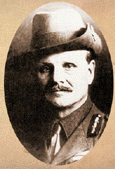
British soldier and
field marshal Birdwood was born in 1865, in India. He died in 1951, in Hampton Court
(Middlesex). He graduated from Clifton College and entered Royal Military College. He
climbed the steps of his military career slowly. First, he became general, in 1917 and
field marshal, in 1925.
He joined Hazara (1891), Isazai (1892), Tirah
(1897-98) campaigns in India; Chagra Kotal, Dargai, Samphagha wars and military operations
in Bazar Valley. During the South Africa Wars (1899-1922), he commanded the cavalry
brigade. Later he became the military secretary of Lord Kitchener. In the Mohmand
Campaign, in 1908, he was designated as the Staff Chief, in the same year he won
"Distinguished Service Order.”
In the First World War, he joined to the
Mediterranean Expeditionary Forces. First he was designated as the commander of the
Australian and New Zealand Corps; later he became the commander of the entire expedition.
Between 1915 and 1916, he commanded the evacuation of the Gallipoli Peninsula, next the
ANZAC Forces and then the French Fifth Army Corps.
Birdwood had won his fame with his excellent command
of the Anzacs. He won the respect and trust of his soldiers. This trust later designed the
victory of the Western Front. In addition, Birdwood was given “Soul of Anzac” title
and a reward of £100.000.
Birdwood commanded the Northern India Forces, in
1920. He became the commander in chief of the Indian Army Corps, in 1925. In 1928, he
became the Baron of Anzac and Totnes. Between 1931 and 1933, he worked as the headmaster
of the Peterhouse. He became the headmaster of Clifton College, in 1935.
Birdwood attended Ataturk’s funeral as the head of
the British representatives, in 1938. Because his leg was injured, he watched the funeral
from the balcony of the Turkish House. By saluting the coffin, he revealed his respect to
the commander; he fought in the Gallipoli.