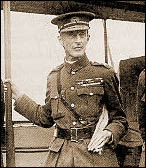
Ian Standish Monteith Hamilton
was born on 16 January 1853, in the island of Korfu, in Greece. When his father's brigade
was sent to India all his family left Britain, but Ian stayed and lived in Argyllshire.
After he finished Cheam and Wellington, he decided to be a soldier. Following his
graduation from the Military College, he joined the Army. He has attended the military
training of an exiled General in Dresden for six months. Later, he went to India
(1872-1902).
He served in South Africa (1881), Egypt (1884-1885) and once more in South Africa
(1899-1902). Following his success in South Africa, he was risen to lieutenant general
rank.
After, he returned to Britain, Kitchener appointed him as his staff and then as the
Commander of the Palace Guardians. In 1904, he was sent to Japan to inspect the
Russo-Japanese War. After the war, he had written his observations in this war.
In 1910, Hamilton was appointed to command the Mediterranean Expeditionary Forces. In
1915, Kitchener ordered him to the Dardanelles in command of an Anglo-French military
force that was to support the British fleet. In 13 March 1915, he left London for a
full-assault on Anatolia. On 16 March, he arrived to the island of Mondros and the total
of his forces was 75.056 soldiers (17.000 of them were French), 140 pieces of artillery
(132 of them were French) and 8 air-planes. On 25 April 1915, the land operation began.
However, the operation was disastrously unsuccessful. Hamilton was highly criticised about
this failure and called back to London (October 1915). Hamilton's reputation was
permanently damaged by the failure of Gallipoli and he received no further command during
the war. He died in 1947, in London.
Some of his Works: A Staff Officer's Scrapbook, 1905-1907; Compulsory
Service, 1910; Gallipoli Diary, 1920, When 1 Was a Boy, 1934; Jean, 1942; Listening for
the Drums, 1944. |
 |